
Concrete sidewalk building in Lomita CA - a walk that drains and isn't slick when wet
Walk heaving, holding puddles or missing entirely? We pour a new concrete sidewalk on a packed base, routed to drain, with a finish that grips.
- Service
- Concrete sidewalk building
- Call
- (424) 667-0052
How can you tell your walk needs replacing?
Edges lifting at the seams
One panel sits higher than the next, usually because roots or shifting soil are pushing up from below. It rarely settles back down, so the lip tends to grow until somebody catches a toe on it.
Puddles that sit for hours
Water that stays on the walk means there's a low spot, and if the slab tilts toward the house it's carrying water right where you don't want it. Left alone, that water softens the dirt underneath and the dip gets deeper.
Slick on wet mornings
A walk troweled glass-smooth feels fine when it's dry and turns slippery with dew, rain or a hose. That's a fall waiting to happen on the path you use every day.
What does building a concrete sidewalk in Lomita involve?
Concrete sidewalk building in Lomita starts with digging out the topsoil and roots and packing the ground firm. Then our crew forms, pours and finishes the walk in panels, so you end up with a level path that drains away from the house and gives you good footing.
Most people call us because an old walk has heaved, sunk or started holding water, or because there's never been a real path from the driveway to the door. The price mostly comes down to how long and wide the walk is, whether old concrete has to be broken out and hauled off, how much digging the base needs and whether the walk crosses the driveway. The schedule turns on those same things, plus the days the concrete needs to cure before you use it. Your written estimate spells out the prep, the joints and the curing in plain words, so you can hold us, or anyone else you're talking to, to the same standard. If the walk reaches toward the street, I'll go over the permit side with you at that visit too.
Details to note before an estimate
- Rough length and width of the walk
- Where it starts and where it ends
- Any driveway or curb it crosses
- Trees growing close to the route
How we build a concrete sidewalk
Before anything gets dug, I walk the route with you, because on a sidewalk where it goes matters as much as the concrete, and we're looking for low spots that would hold water or send it toward the house. Then our crew digs out the topsoil and roots and packs the subgrade, the dirt the slab sits on, since a walk poured on raked dirt settles right along with it. If the budget gets tight, that base is the last thing I'd cut, because you can't see it on day one, yet it's what keeps the walk flat years later. We set the forms so the walk sheds water, pour while the day is still cool so the top doesn't dry out weak and dusty, and cut control joints, straight lines that give any crack a place to run, early enough that they do their job. Last comes a broom finish, a light texture dragged across the wet surface, so you've got grip on wet mornings.
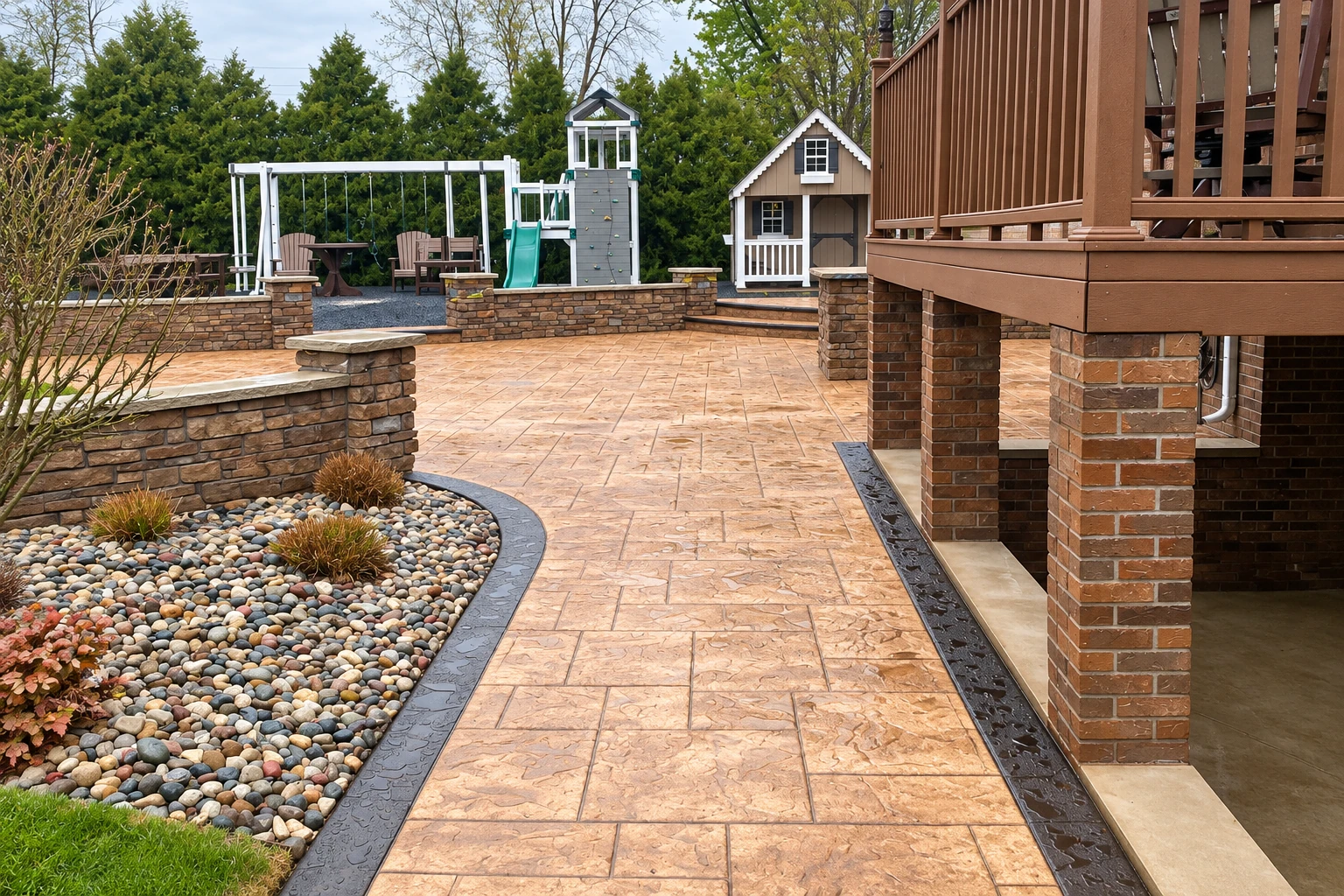
A new walk often ends at the garage, and if that slab is cracked or sloping the wrong way, it makes sense to look at garage floor concrete while we're planning the route. If you'd like the front walk to look like more than plain gray, decorative concrete can add color or a pattern, and I'll help you pick one that still has good grip.
Work that often goes with a new walk
Garage floor concrete
If your garage slab is cracked or sloping the wrong way, a new floor can be poured while our crew is already set up nearby.
Decorative concrete
For a front walk people see every day, color, pattern or a scored border can make plain concrete fit the house while keeping safe footing.
What happens after you call about a new sidewalk?
Call or send a note
Call (424) 667-0052 or use the form and tell us roughly where the walk goes. We'll get back to you and set a time for me to come out.
Walk the route together
I look at the route with you, checking low spots, trees and any driveway crossing. Then I send a written estimate that says what we'll do and why, including who handles any permit step.
Prep, pour and finish
I lead the crew through the dig, the base, the forms and the pour. I check in with you before the pour, so you see the base and the layout before any concrete goes in.
Cure and final walkthrough
The walk stays off-limits while it cures, and we'll tell you when it's ready to use. At the end I walk it with you to make sure it's what we agreed on.
Questions before you build a concrete sidewalk
How much does a concrete sidewalk cost in Lomita?
Around Los Angeles, a residential concrete sidewalk or walkway usually runs about $3.50 to $15 per square foot. That's a wide range built from estimates that differ a lot, so treat it as a rough guide. Your written estimate gives you the figure for your own walk, with the prep, joints and curing spelled out.
Who issues permits for sidewalk work near the street in Lomita?
The city's Public Works Department issues Public Works Permits for work in the city's right of way, the public land along the street, and it also looks after city streets and trees. You can reach them at 310-325-7110 x155. If your walk reaches toward the street, I'll go over the permit side at the estimate, explain who handles each step and walk you through any part that falls to you.
How long does new concrete take to cure?
Curing usually runs 3 to 7 days, starting right after the concrete is finished, and it simply means keeping the slab moist so it can gain its strength. Concrete left to dry out can lose as much as 50 percent of its potential strength, so we keep the walk damp through that stretch and tell you when it's ready to use.
Can an unlicensed person build a small concrete walkway in California?
Only a very small one. In California, someone without a contractor's license can take on minor work up to $1,000, and only when the job needs no permit and they don't hire anyone to help. Past that, the state's concrete license covers forming, pouring and finishing flatwork, the flat concrete like walks and patios, and we're fully licensed and insured.
How do I fix a sidewalk that tree roots have lifted?
Find out what pushed it up first, because grinding down the lifted edge leaves the cause in place. Roots, a washed-out base, poor fill or bad drainage can all lift or drop a panel, and the lasting fix is usually new panels on a base that deals with whatever caused it.
Does a concrete walkway need to be thicker where it crosses a driveway?
It can, because the part cars drive over may need to be thicker or reinforced with rebar, steel bars set inside the slab to hold it together under weight. The base matters there too, since even support where the walk meets the driveway edge or crosses utility lines keeps one panel from sinking faster than the rest.
Get a written estimate for your new sidewalk
Send the form and we'll reply within one business day to set up a visit. I'll come out, look at the route with you and send you a free written estimate, with no obligation.
Explore our services and areas
Services
- Concrete driveway building
- Concrete patio construction
- Stamped concrete services
- Garage floor concrete
- Decorative concrete
- Concrete retaining walls
- Concrete floor installation
- Concrete pool decks
- Concrete steps construction
- Slab foundation building
- Foundation installation
- Concrete parking lot building
- Concrete footings
- Foundation raising
- Concrete cutting
Plan your new sidewalk with us
Have the walk's rough size, route and any driveway crossing handy when you call, and you'll be hiring an insured crew, with your satisfaction, guaranteed.