
Garage floor concrete in Lomita CA - a slab ready for your cars and the finish you want
Cracked, sinking or dusty garage floor? We pour a new slab on a packed base, ready for cars and any coating you plan.
- Service
- Garage floor concrete
- Call
- (424) 667-0052
How can you tell your garage floor is due for replacing?
Cracks that keep growing
A crack that widens each year, or one side sitting higher than the other, usually means the ground under the slab moved or the base was never packed. Left alone, water gets into the gap and the broken pieces keep shifting, so a patch job turns into a tear-out.
Water pooling on the floor
When rain or hose water sits in the middle of the garage or runs toward the house door, the floor has settled or was poured without a fall toward the door. Every wet season soaks the ground underneath a little more, and the low spot gets lower.
Dust and flaking on top
A floor that sheds gray dust or flakes under the tires usually has a weak top layer, often from being finished in the heat or dried out too fast. A coating won't hold well on it, and the wear spreads out from wherever you park.
What does a new garage floor in Lomita involve?
Garage floor concrete is flatwork, our word for flat slabs poured on the ground, and for a garage in Lomita it means breaking out a tired floor or starting from bare dirt, then forming, pouring and finishing the slab your cars park on every day.
We're based in Lomita and work across the cities around it, and most garage floor calls we get are about an old slab that's cracked, sunk or dusting, or a new garage that needs its first floor. The price moves with the size, whether the old concrete has to be broken out and hauled off, how much digging and packing the ground needs, the steel inside and whether you'll coat the floor, because that changes what goes under it. The schedule turns on the tear-out, the weather on pour day and the curing time after. Your written estimate spells out the prep, the joints and the curing in plain words, so you can hold us, or anyone else you're talking to, to the same standard.
Details to note before an estimate
- Rough garage size or number of cars
- Old slab to remove or bare ground
- Cracks, sinking or water coming in
- Plans to coat, heat or finish it
How we pour garage floor concrete, start to finish
We break out and haul off the old floor, then dig down to firm ground and pack the subgrade, the soil the slab sits on, because a base that's only raked level settles and takes the slab with it. Tell us early if you plan to coat the floor or leave it bare, since that changes what goes under the slab. We check where the water runs so the floor falls toward the door and not toward the house, set rebar, the steel bars that hold the slab together if it cracks, up on supports, and pour in the cooler part of the day, because a pour in midday heat can leave a weak, dusty top. Then we cut control joints, shallow grooves that give the slab a straight line to crack along, and I'll show you where they go and why a little fine cracking is normal before we keep the slab damp while it cures, the slow hardening that sets its strength. If the budget gets tight, I'd rather trim the finish than the base, because nobody sees the base on day one but it decides how the floor holds up for years.
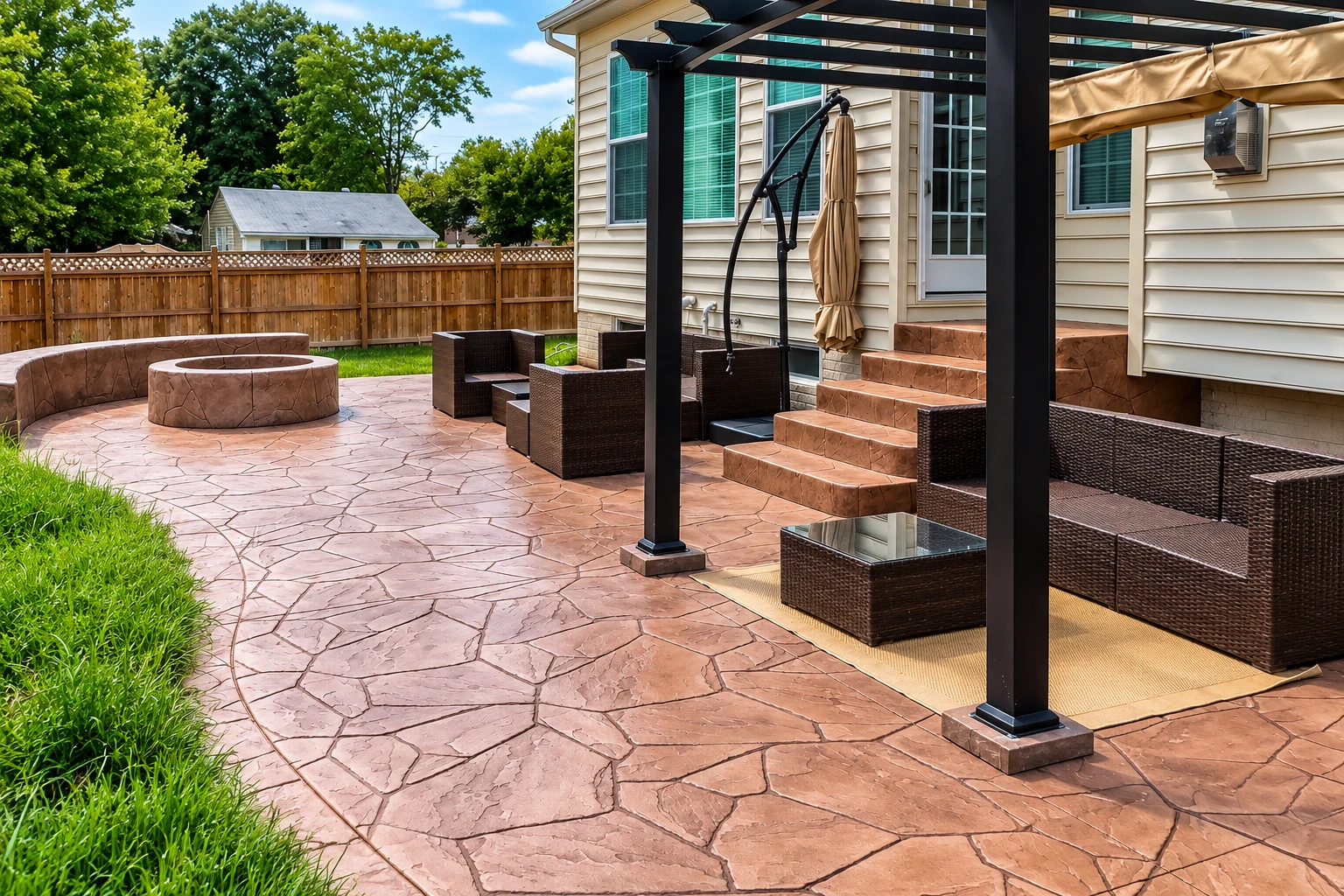
Some jobs reach past the garage door. If you'd like the floor or the apron out front to be more than plain gray, we do decorative concrete with color and texture, and when a garage is dug into a hillside lot, concrete retaining walls keep the bank from pushing on the slab or spilling dirt across it.
Other concrete work around your garage
Decorative concrete
A tinted or textured finish can make a garage you also use as a workshop or gym feel like part of the house.
Concrete retaining walls
Where the ground beside or behind the garage is higher than the floor, a concrete wall keeps that soil and its runoff where they belong.
What happens after you call about a garage floor?
Call or send us a note
Call (424) 667-0052 or fill in the form with the garage size and whether you'll coat the floor or leave it bare. We set a time for me to come out and see it.
Look at your garage together
I look at the old floor, the ground and where the water goes, and we go over the permit side, which office is involved and who handles each step, and I walk you through any part that falls to you. Then you get a written estimate that says what we'll do and why, so you know the price before anything starts.
Prep, pour and cut joints
I lead the crew through the tear-out, the base and the pour. I check in with you before we pour, so the floor height, the fall to the door and the joint lines are what you expect.
Check the finished floor
At the end I check in again, walk the floor with you and go over the joints and how to treat the slab while it cures. Your satisfaction, guaranteed.
Questions before you book a garage floor
How much does a garage floor cost in the Los Angeles area?
A 400 to 600 square foot garage floor slab in the Los Angeles area usually costs about $4,000 to $9,000 per job. That's the usual range for the slab around here, not our price. Your own figure comes in the written estimate after I've seen the garage.
What causes a new garage floor in Lomita to crack?
Drying and ground movement cause most of it, and some fine cracking and slight curling, the edges lifting a little, are normal on any slab, even one designed and built right. Homes on expansive soil, ground that swells and shrinks with moisture, tend to show more hairline cracks than homes on sandy soil. The control joints we cut give most of that cracking a planned line to follow.
How thick should a concrete garage floor be for cars?
Four inches is the practical standard for a garage that parks cars, according to one garage slab guide, so check that every bid you get lists the thickness. The same guide treats steel bar or wire mesh set up inside the slab as common practice, with fiber in the mix as a reasonable extra, not a replacement for the steel.
Do I need a vapor barrier under my garage slab?
Usually only if you plan to coat the floor or finish the space, according to that same garage slab guide. It says to plan a vapor retarder, a layer that stops moisture from the soil rising through the slab, for an epoxy or polyaspartic coating or a garage you'll heat and finish later. A bare broom-finished floor, the light texture that gives tires and shoes some grip, in an unheated garage needs none.
Who can pour my garage floor in California?
A contractor licensed by the state's Contractors State License Board, whose concrete contractor class covers flat work like a garage floor. The board has to license anyone who builds or alters a structure when the job needs a building permit or uses additional workers, or when labor and materials total $1,000 or more. We're fully licensed and insured.
How do I compare concrete bids for a garage floor?
Line the bids up on thickness, base prep, steel and joints, then ask each bidder how they time the finishing, the joint cutting and the curing. Poor timing on those steps can lead to cracking, dusting, high or low spots and poor drainage. A bidder who can explain their timing plainly is one you can hold to it.
Get a written estimate for your garage floor
We reply within one business day. I come out to look at your garage for free, with no obligation, and then send a written estimate that says what we'll do and why.
Explore our services and areas
Services
- Concrete driveway building
- Concrete patio construction
- Stamped concrete services
- Concrete sidewalk building
- Decorative concrete
- Concrete retaining walls
- Concrete floor installation
- Concrete pool decks
- Concrete steps construction
- Slab foundation building
- Foundation installation
- Concrete parking lot building
- Concrete footings
- Foundation raising
- Concrete cutting
Book a look at your garage floor
Have the garage size and your coated or bare plan ready when you call (424) 667-0052, so the first visit can settle what goes under the slab.